
Apartment
Bedroom
Apartment
Office
Bathroom
Conference room
Office
Bedroom
Apartment
Apartment
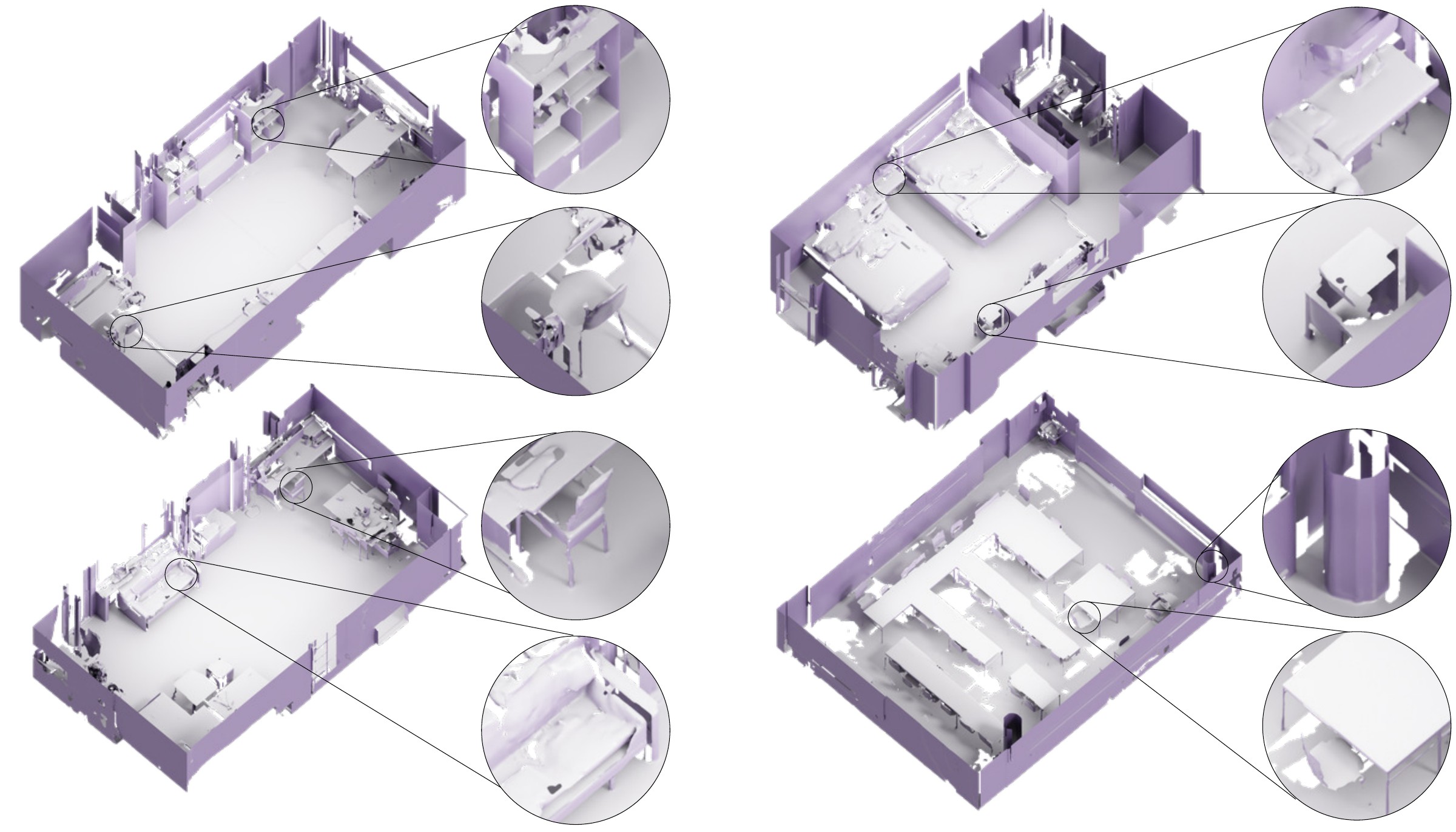
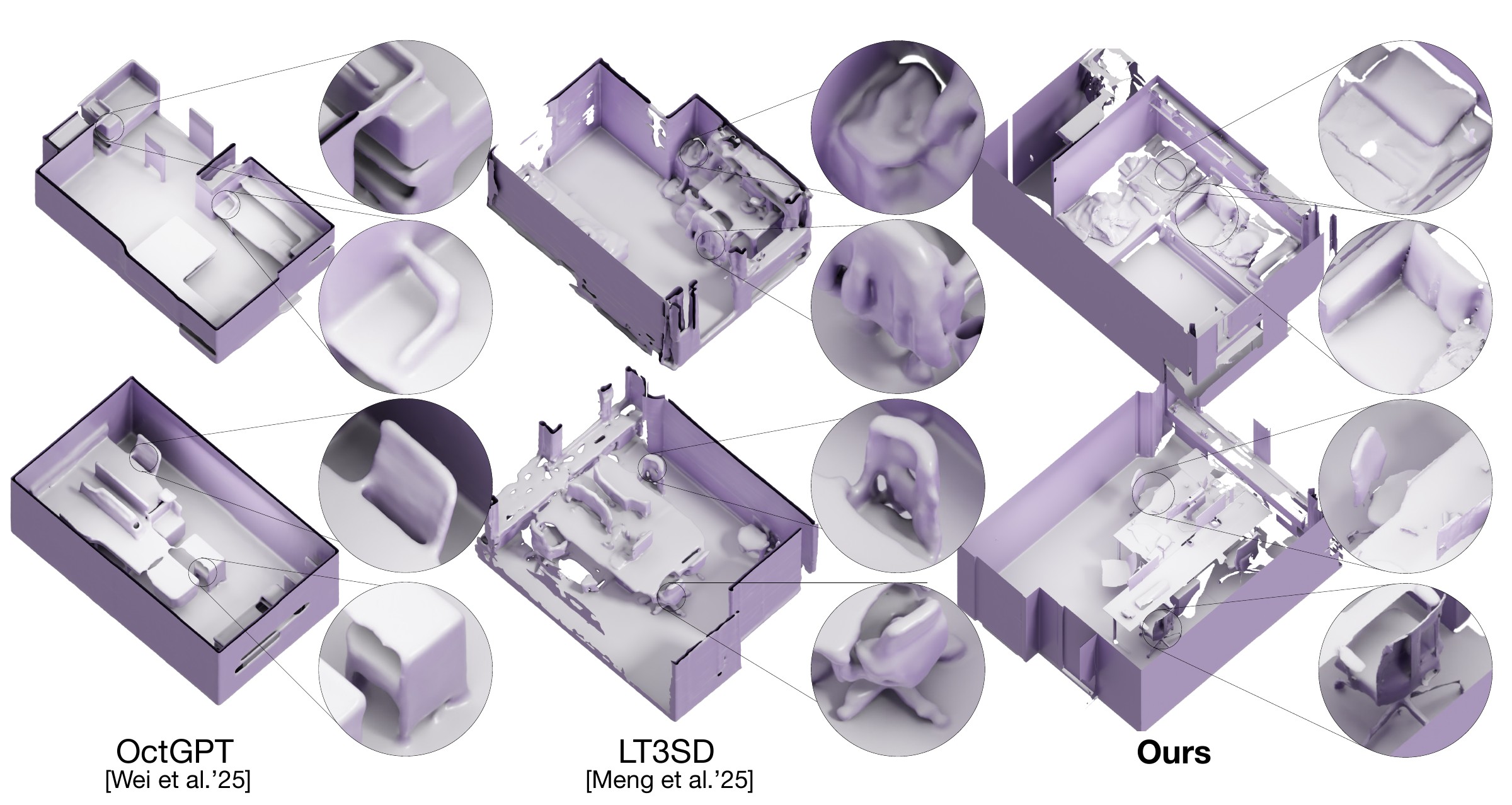
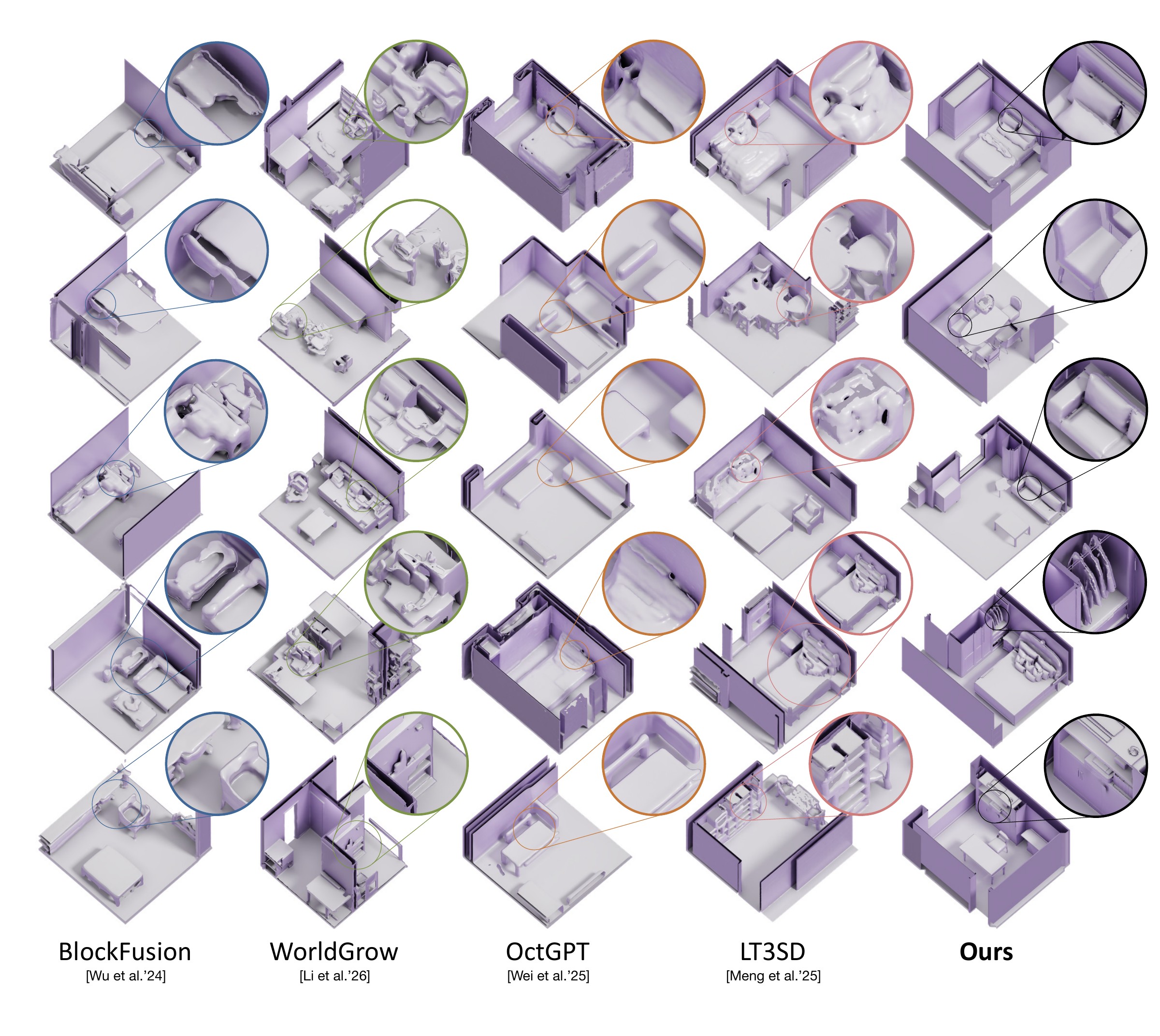
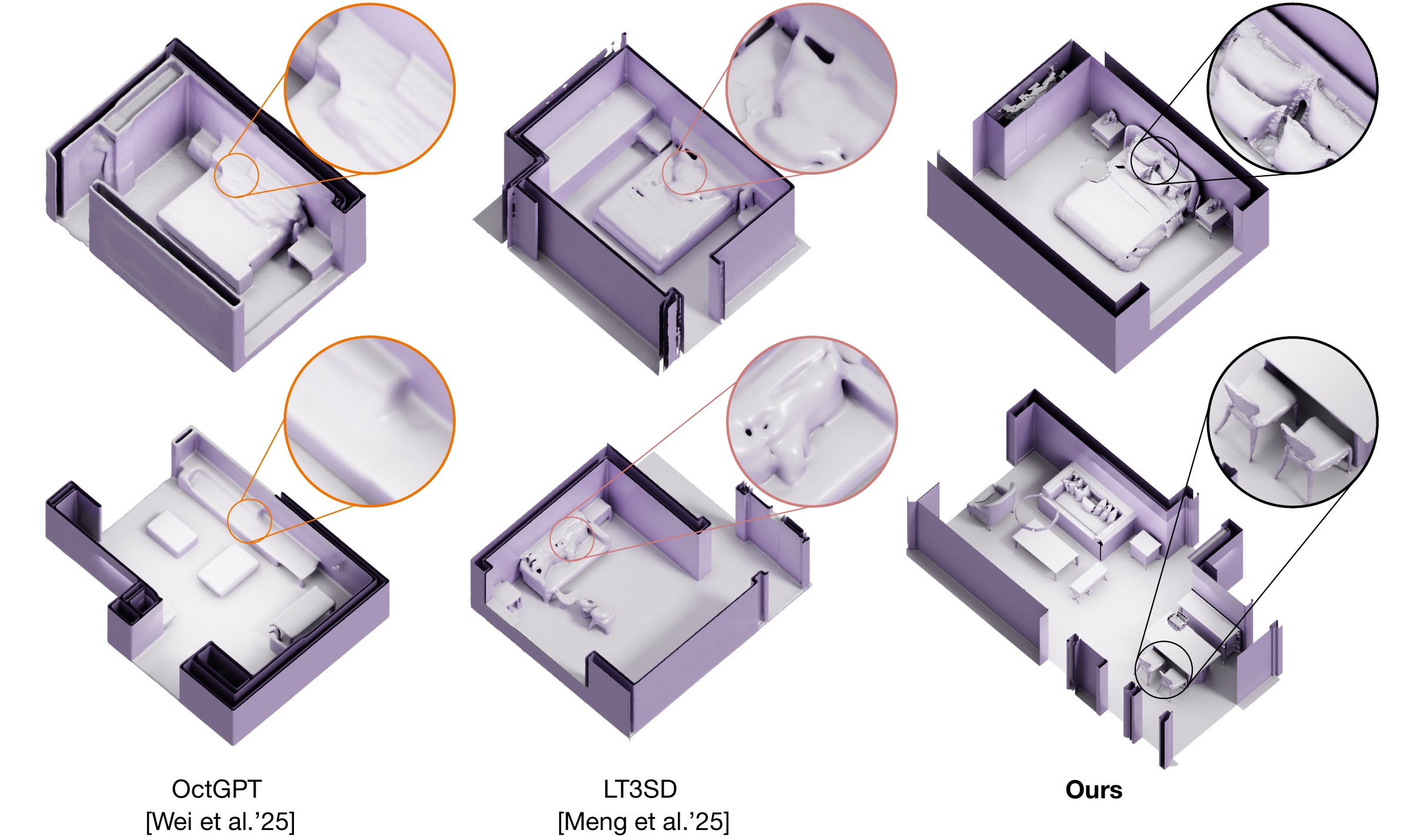
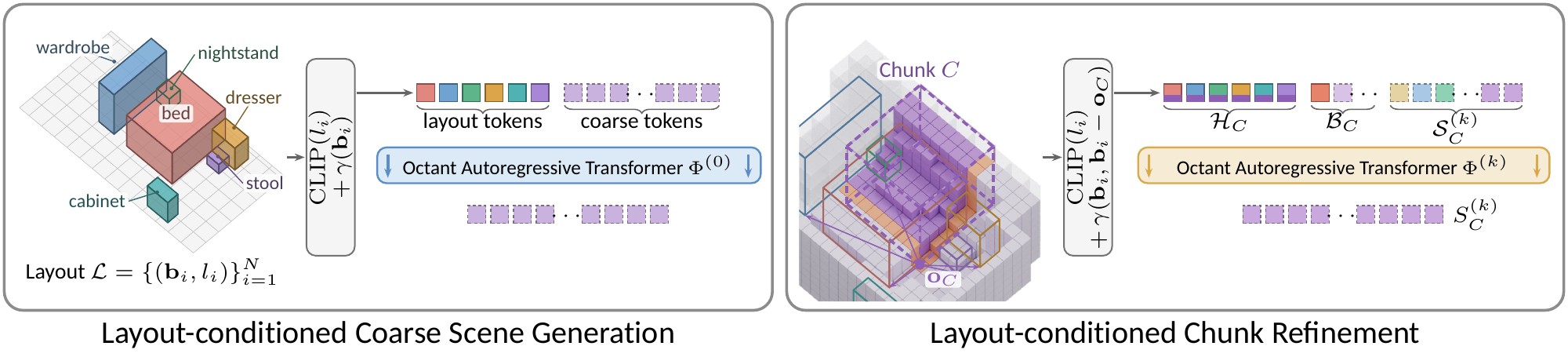
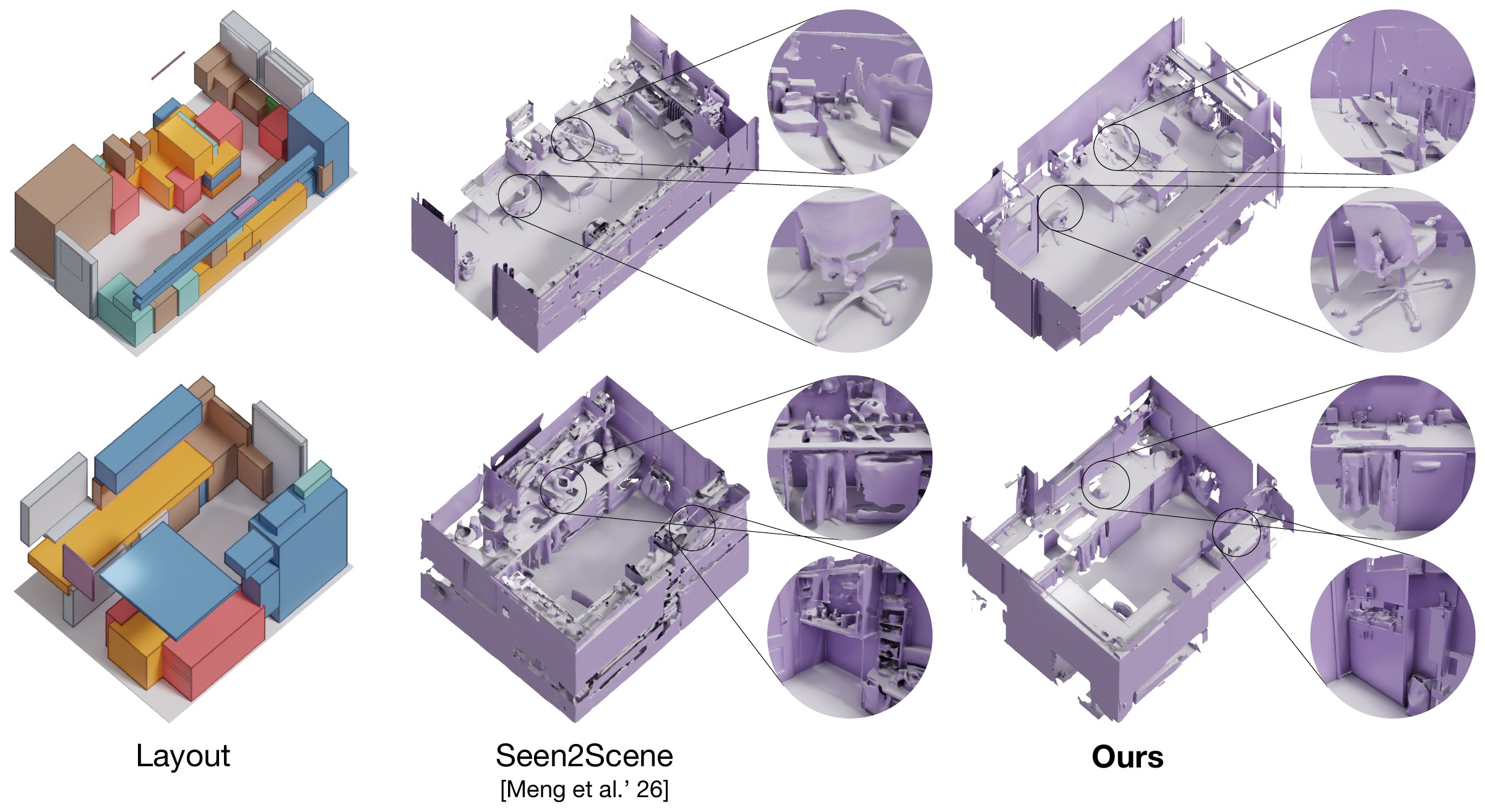
High-resolution 3D indoor scene generation is crucial for immersive applications such as virtual reality, spatial computing, and robotics simulation. We introduce VoxLution, a coarse-to-fine transformer-based approach that generates high-fidelity indoor scenes with rich details, overcoming the overly smooth geometry typical of existing generative models. First, we generate a low-resolution spatial layout; then, based on this structural information, we progressively refine the scene geometry locally in chunks. Key to our approach is formulating 3D super-resolution as a sequence modeling problem over multi-resolution sparse voxel grids. To achieve this, we introduce a training-free, resolution-invariant tokenization scheme that compactly encodes the geometric information of eight octants into a single decimal number. We formulate the transformer sequence to include multiple resolutions, allowing the coarse layout to guide the generation of fine local details. To ensure coherence across local chunks, we incorporate adjacent chunk boundary information directly into the transformer sequencing. VoxLution achieves scene generation at a finer voxel resolution than existing baselines, demonstrating state-of-the-art performance on standard benchmarks with 59.6% lower FPD and 51.1% lower FID on 3D-FRONT, and 70.5% lower FPD and 73.8% lower FID on ScanNet++.
Apartment
Office
Bedroom
Kitchen
Conference room
Living room
Bathroom
Office
Apartment
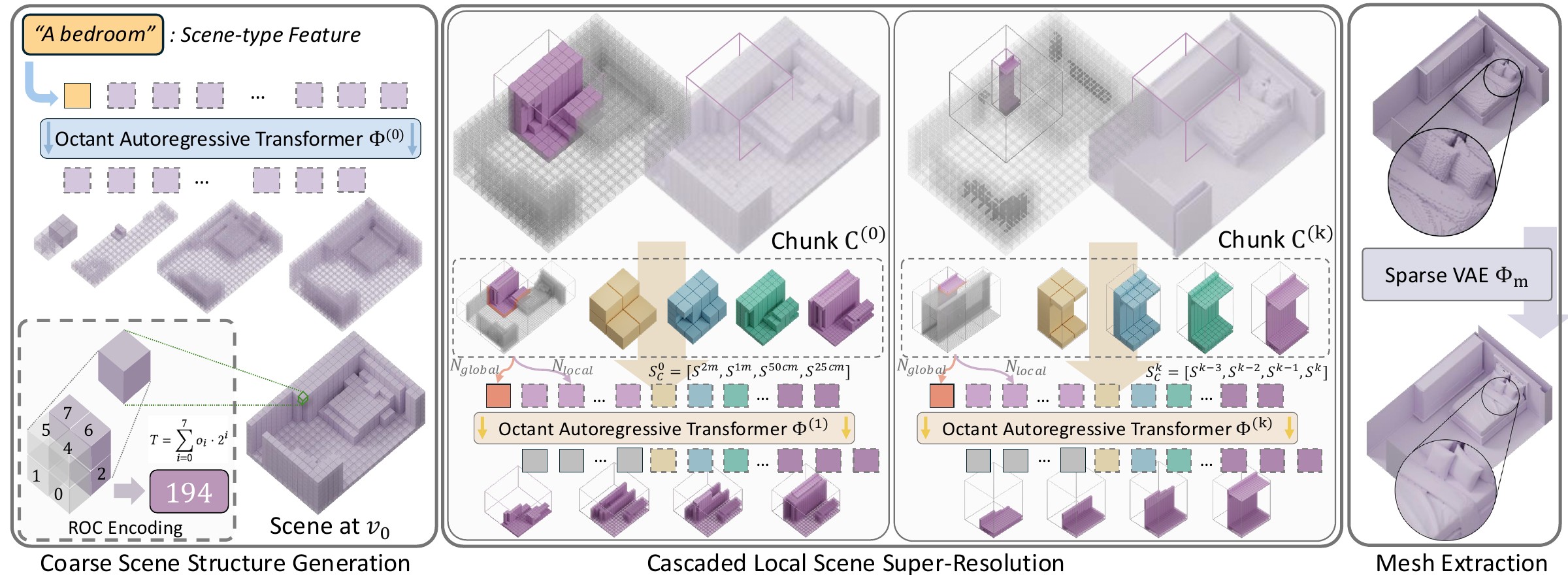
VoxLution synthesizes a scene as a multi-resolution autoregressive cascade. A coarse scene transformer first generates the coarse scene structure as a single-level token sequence, conditioned on the scene type. Cascade transformers then refine the scene chunk by chunk, each stage doubling the resolution, down to 1.5625 cm voxels.
@article{gao2026voxlution,
  title   = {VoxLution: Evolving Voxels for High-Fidelity 3D Scene Generation},
  author  = {Gao, Daoyi and Zhang, Xinyi and Bokhovkin, Alexey and Li, Lei and Dai, Angela},
  journal = {arXiv preprint arXiv:2610.41501},
  year    = {2026}
}This project is funded by the ERC Starting Grant SpatialSem (101076253). We also acknowledge the EuroHPC Joint Undertaking for providing access to the EuroHPC supercomputers MareNostrum 5, hosted by the Barcelona Supercomputing Center (BSC), Spain, and LEONARDO, hosted by CINECA, Italy.